
Robotics middleware · Simulation facility

Middleware that helps robots see, think and walk.

We develop robotics middleware for robot manufacturers and integrators in Europe, North America and beyond. Our focus is human-robot interaction, visual SLAM, vision-language AI and learned locomotion, all developed and tested in our own simulation facility.

HRIreading people's reactions
V-SLAMthe robot's compass and map
VLMthe robot's brain
RLlocomotion that learns

What we provide

Four layers of a capable robot

Each layer works on its own, or together as one system: the map tells the brain where things are, the brain sets goals, the legs get there, and HRI keeps the people around the robot comfortable and safe.

Human-robot interaction

Software that reads a person's face, gaze, head movement and voice, learns their normal behaviour, and tells the robot when they look confused, surprised or inattentive, so it can slow down, explain or ask.

V-SLAM

Visual and visual-inertial SLAM, the robot's compass and map: localisation and mapping from cameras and IMU, integrated with ROS 2 and tuned for the shaking and blur of walking robots.

VLM task intelligence

Vision-language models as the robot's brain: understanding the scene and an everyday instruction, then choosing the next goal for navigation and manipulation skills.

RL locomotion

Walking policies for quadrupeds and humanoids, trained with reinforcement learning in simulation, checked in a second simulator, and deployed on the real robot.

Simulation facility

We have our own simulation facility

Every robot behaviour we deliver is first built, trained and tested in simulation. It's faster, safer and repeatable, and the simulator knows the exact truth to measure against. Our team has delivered more than 350 training simulators over two decades; we bring the same discipline to robotics.

Real-time simulation

MuJoCo

Accurate contact physics for legged robots. We run complete robots in real time: cameras, lidar, mapping, path planning around people, and the walking controller, in one loop.

Real-time simulation

Genesis

A fast GPU physics platform with built-in photorealistic rendering, for real-time tests where camera images matter, such as V-SLAM and VLM perception.

Training

NVIDIA Isaac Sim & Isaac Lab

Thousands of robots trained in parallel on GPUs, with randomised terrain, pushes and physics, for robust locomotion policies; photorealistic scenes for perception data.

Examples from our MuJoCo real-time simulation

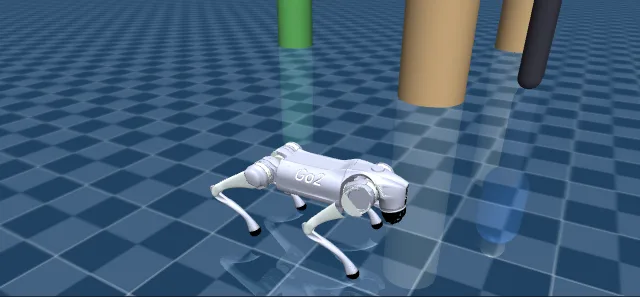
Quadruped robot trotting in the simulator
Quadruped locomotion: a learned RL policy and model-predictive control compared on the same terrain, including ramps.
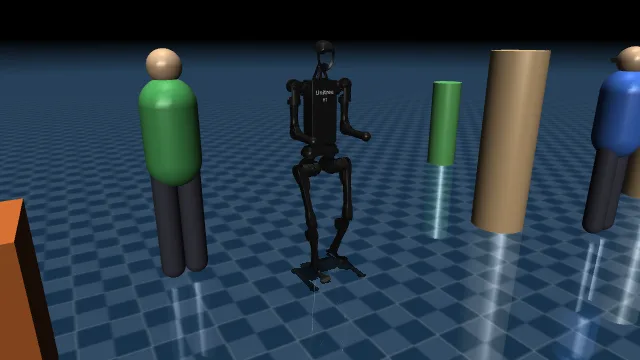
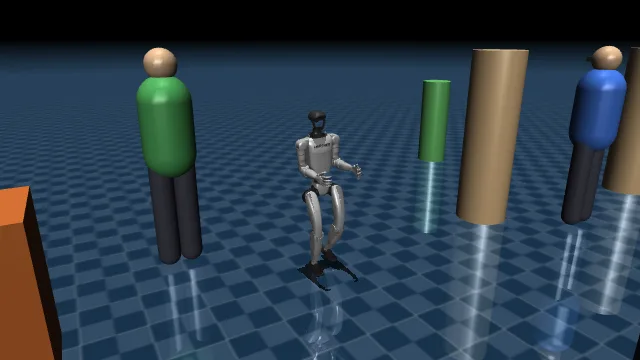
Full-size humanoid walking between people and posts in the simulator
Human-aware navigation: the robot keeps a comfortable distance from people and steps aside rather than blocking their way.
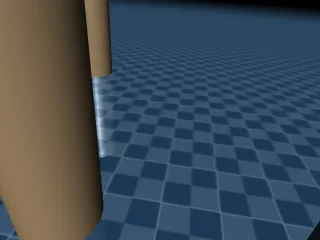
Colour image from the robot's head camera
What the robot sees: its simulated head camera, in colour, the input for mapping and the VLM.
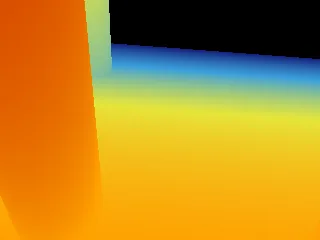
Depth image from the robot's head camera
The same view in depth: near is red, far is blue. It becomes 3D points for the map.

Genesis and NVIDIA Isaac examples will be added here as projects are completed.

End-to-end custom solutions

Your robot, our intelligence: we can build it

We don't only license software. We can take a robot from another manufacturer, add our algorithms, and deliver a complete working system. Two examples, then a full custom project:

Humanoid robot in the simulator
Example 1 · Human-robot interaction

A service robot that notices when people are confused

Robot hardware from another manufacturer, such as a humanoid or social robot, combined with our confusion-detection algorithm.

  • Our software reads face, gaze, head movement and voice from the robot's own camera and microphone
  • It learns each person's normal behaviour and flags confusion, surprise or inattention
  • The robot responds: it slows down, repeats, explains or asks if help is needed
  • Suited to reception, healthcare, retail and collaborative work
Quadruped robot in the simulator
Example 2 · Quadruped locomotion

A Unitree quadruped with our RL locomotion

A Unitree robot dog, such as the Go2, running walking policies trained by our team for your terrain and task.

  • Policies trained in NVIDIA Isaac Lab with thousands of robots in parallel
  • Checked in MuJoCo and Genesis before running on the real robot
  • Tuned for your ground: slopes, stairs, gravel or factory floors
  • Combined with our V-SLAM and navigation for autonomous inspection and patrol

End-to-end custom projects

A complete robotics solution, from idea to deployment

For custom projects we build everything, end to end: we choose the robot, develop the software for your task, train and test it in our simulation facility, and deploy it on site. You get one complete, working solution from one team.

01

Robot & hardware

Selecting the robot, sensors and onboard computer for the job.

02

Your custom task

Inspection, patrol, delivery, guidance or exploration, defined with you.

03

Full software stack

V-SLAM, VLM, RL locomotion and HRI, integrated and trained in simulation.

04

Deployment & support

Installed on your robot, tested on site, documented and supported.

Example 3 · Custom project

A Unitree Go2 that explores unknown terrain on its own

The task: send a Unitree Go2 quadruped into a forest, mountainside or outdoor site it has never seen, have it map the area, find and report what matters (for example, people, trails, fallen trees or hazards), and come back. Everything below runs on the robot, in real time.

↺ each new view updates the map, and the loop repeats until the area is explored

  1. Simulate the unknown world. We generate many forests and outdoor sites the robot has never seen in our simulation facility, with trees, rocks, fallen logs, slopes and people.
  2. Train the legs. The Go2's RL locomotion policy is trained in NVIDIA Isaac Lab on mixed terrain, then checked in MuJoCo and Genesis.
  3. Teach the brain. The VLM is set up to choose the next place to explore and to recognise what to report, tested on thousands of simulated runs.
  4. Deploy on the robot. V-SLAM, the VLM and the RL policy run onboard the Go2. We test at your real site, tune, and hand over with a map viewer and reports.

What you receive

  • ROS 2 packages and nodes
  • Trained policies in ONNX, ready for onboard computers
  • Python and C++ interfaces
  • Simulation models and test scenarios of your robot
  • Documentation, integration support and training
  • Source code or licensed binaries, as agreed

Have a robot in mind?

Tell us about your robot and the task. We'll propose a simulation-first plan and a working demonstration.

Start a conversation

How we work

Simulation first, hardware second

  1. 01

    Requirement

    We define the robot, the task, the environment and how success will be measured.

  2. 02

    Simulate

    We model your robot and its environment in our simulation facility and build the first version there.

  3. 03

    Train & validate

    Policies are trained in NVIDIA Isaac and checked in MuJoCo or Genesis before any hardware moves.

  4. 04

    Integrate & support

    We deploy on the real robot, tune, document and support it, remotely or on site.

Let's make your robot smarter

Middleware, a custom solution, or a simulation study: talk to our robotics team.

Contact the robotics team